Family communication patterns theory, and group chats
The two dimensions behind the four family types, where they came from, how they are scored, and why a group chat thread is not what the theory is measured on.
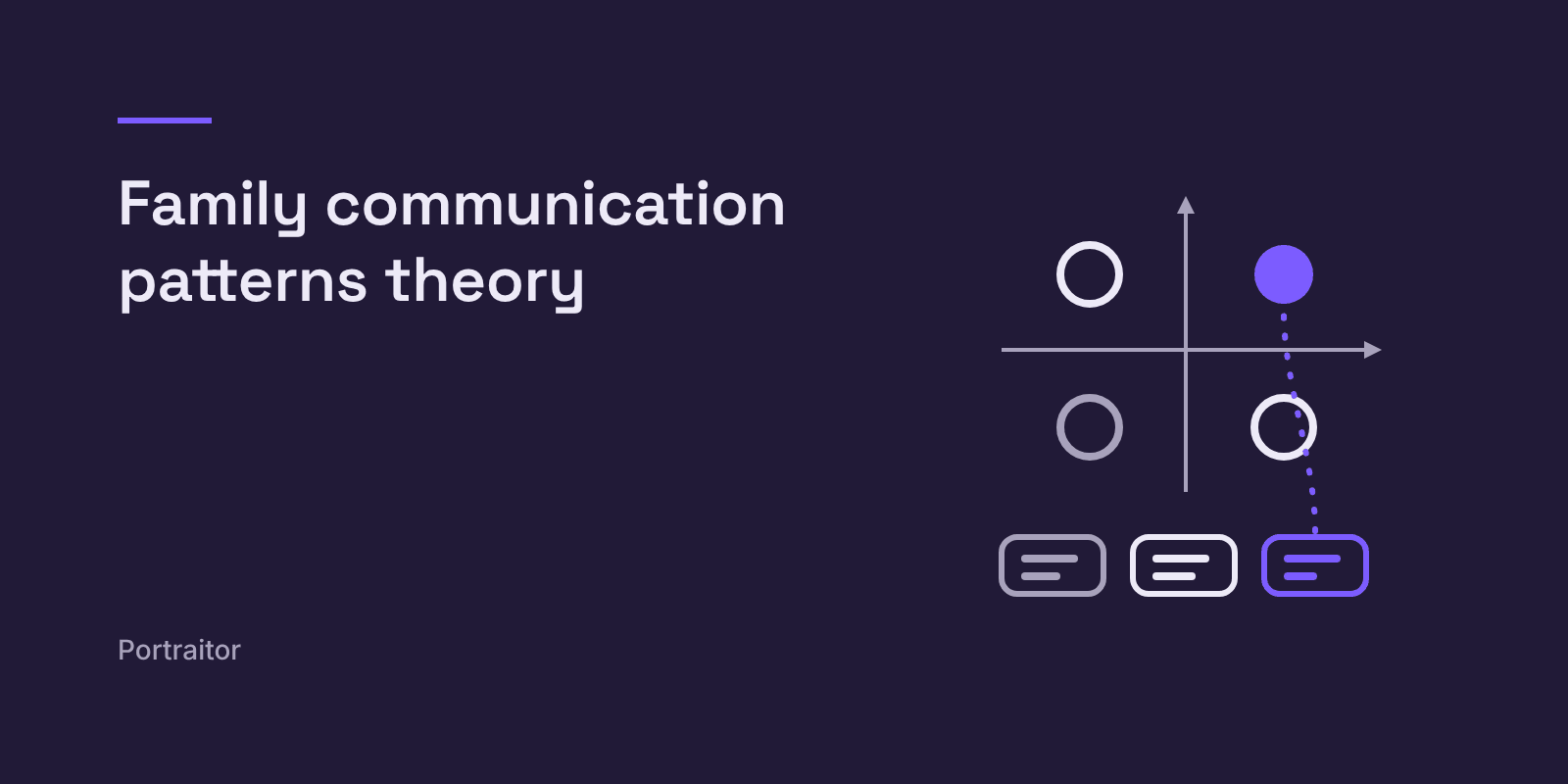
Family communication patterns theory describes two dimensions, conversation orientation and conformity orientation, and the four family types they produce. Ascan Koerner and Mary Anne Fitzpatrick’s dimensions are scored from what family members report about their own family on a questionnaire, which is not the kind of thing a group chat thread contains.
The four family types people quote from this theory, pluralistic, protective, laissez-faire and consensual, are corners of a grid rather than labels. The grid has two axes, and a family’s position on either axis comes from family members answering questions about their own family.
That second part is usually the part that goes missing, and it is the part that decides what an exported conversation can and cannot do with the theory.
Where the two orientations came from
The theory builds on the work of the mass communication scholars Jack McLeod and Steven Chaffee. McLeod looked at how families talked about political messages, using either conformity or conversation.
Koerner and Fitzpatrick named the repeated habits that do this work family communication patterns, which the chapter outline defines as “repeated communication beliefs and behaviors that orient family members towards a shared reality”.
The shared reality itself they call coorientation, “a situation where two or more individuals focus their cognitive attention on the same object in their social or physical environment and form beliefs and attitudes about the object”. Coorientation does not mean that family members always agree with each other, although the outline records that most families experience pressure to achieve at least some level of agreement. Conversation and conformity are two different means of reaching it.
The chapter outline quoted throughout this article is a secondary source. It sits on the companion website for the textbook A First Look at Communication Theory, which summarizes the chapter and quotes Koerner and Fitzpatrick with attribution rather than being a paper by them. The primary statements of the theory are Koerner and Fitzpatrick’s “Toward a theory of family communication”, published in Communication Theory in 2002, and “Understanding family communication patterns and family functioning: The roles of conversation and conformity orientation”, published in Communication Yearbook the same year. Both carry full citations on the University of South Carolina repository records linked below. The companion site’s own primary sources page showed no citation list at all on the day it was read for this article, so the primary works are named here from those repository records.
Conversation orientation and conformity orientation, as defined
A high conformity orientation creates a shared reality by emphasizing parental authority. A high conversation orientation does not emphasize parental authority or knowledge; there, the outline says, a shared reality emerges from open discussion and debate of ideas.
Each orientation is described as a distinct way of creating a shared social reality, which is why the theory keeps them as separate axes rather than two ends of one scale. Almost all families contain some mixture of conformity and conversation orientation, although the outline records that the two are inversely related.
The four family types the two dimensions produce
Pluralistic families exhibit high conversation and low conformity orientations. Protective families are the reverse, stressing high conformity with low conversation orientation. Laissez-faire families, which the outline glosses as “hands-off”, are low in both. Consensual families report highs in both.
The outline’s wording on the last one is worth keeping exactly: consensual families report highs in both orientations. The type is a summary of what members of the family said about it, not an observation made of the family from outside.
What the research found about the types
Most of what the theory gets cited for is associations of this kind, and the chapter outline collects several of them.
In research on the first year of college, students from protective families were much more likely to report that their parents did things like ask personal questions, read their emails, or check on social media feeds. The outline records that this did not occur in either laissez-faire or pluralistic families, which fits a low conformity orientation, and that in consensual families, despite high conformity orientations, parents do not snoop. Privacy invasions were tolerable at first and got worse later on. Early on they did not affect well-being, and both high conversation and low conformity orientations were helpful to mitigate the negative effects. Consensual parents were less likely to pry, and their children were in turn less likely to defend their parents’ actions.
The outline also reports effects that outlast the household. In the workplace, employees who were raised in high conformity households as children are much more likely to keep their on-the-job concerns to themselves. Elizabeth Graham found that adults raised in consensual families were more likely to discuss and participate in political activities than adults raised in other family forms, and that children from laissez-faire households were the least politically engaged as adults. Emily Rauscher found that family communication patterns span generations, though they are capable of change with deliberate choices.
Underneath the associations, Koerner and Fitzpatrick argue that communication patterns are schema, meaning mental representations of knowledge, and that families equip children through them with schema for understanding all social relationships. The abstract of their 2002 Communication Theory paper, on the University of Minnesota research record, describes a theory of family communication “based on the schematic representation of relational knowledge”, and says the authors describe the schema’s location in cognition, its content, and its role in family communication.
The outline is also candid about the weak point. It says the theory leads family communication theory because of its relative simplicity, and that its testable hypotheses have let scholars predict how family communication patterns are associated with many diverse outcomes, but that its weakness lies in the ability of conformity orientation to explain the data. One of the two axes carries the theory; the other is the one under argument.
The orientations are measured, and measured one member at a time
The dimensions have an instrument behind them. Fitzpatrick and Ritchie’s 1994 paper in Human Communication Research, whose abstract is published on Portland State University’s repository, derived its hypotheses “by theoretically relating the Relational Dimensions Inventory and the Revised Family Communication Patterns instrument”, and ran its analyses on “a random sample of 169 families”.
The same abstract shows how the scoring behaves in practice. It reports that in families headed by Traditional, Separate, and Separate/Traditional couples, “all three family members saw the family interaction as high on conformity orientation”. Three people in one household each answered separately, which is why the paper is subtitled “Multiple Perspectives on Family Interaction”. An orientation, in that design, is a reading a family member gives of their own family, and the finding is about where those readings converge across a sample. The abstract presents a further scale, Family Communication Environment, for the same purpose.
So the evidence has a definite shape: a questionnaire, answered separately by several members of each family, across many families at once. No step in it converts one household’s messages into a score. That is a common property of interpersonal theories built on instruments, and it is worth comparing with how communication accommodation theory was measured, which has the same gap between the instrument and a transcript.
What a family group chat is not
A family group chat is one thread in one app. It holds the messages people chose to send there, and nothing from the phone calls, the kitchen table, the car, or the other threads the same people use. The theory’s two dimensions were not derived from message logs, and no part of the research reads a transcript to place a family on either axis.
A software reading of an export narrows the picture again rather than widening it. Portraitor’s uploader asks you to “pick the one person you want a Portrait of”, and its own copy says that “their messages are read; everyone else stays context”. One participant is read. There is more detail on what a group chat reading does with everyone else, and on what it looks like when the person read is you. What comes back is described in what a portrait actually reports.
Family communication patterns theory offers no procedure for placing a family in one of its four types from a chat thread, and no chat reading produces one. The honest limit is narrower still: a portrait describes how one person wrote in the messages that were uploaded, over the period that was chosen.
Put the two together and the useful version of the reading is the narrow one: a chat analyzer that reads one participant, over a conversation you pick, pointed at how that person wrote in it. The boundaries of that are set out in what a chat reading cannot tell you.
If the question you actually have about a family thread is who the information in it belongs to, that has a named theory of its own, and communication privacy management theory fits it better than this one does.
Frequently asked questions
Frequently asked questions
What are the four family types in family communication patterns theory?
They are pluralistic, protective, laissez-faire and consensual. Pluralistic families exhibit high conversation and low conformity orientations, protective families stress high conformity with low conversation, laissez-faire families are low in both, and consensual families report highs in both.
Who developed family communication patterns theory?
Ascan Koerner and Mary Anne Fitzpatrick. Their chapter is the one carried in the textbook A First Look at Communication Theory, and the theory builds on earlier work by the mass communication scholars Jack McLeod and Steven Chaffee on how families talked about political messages using either conformity or conversation.
What is the difference between conversation orientation and conformity orientation?
A high conformity orientation creates a shared reality by emphasizing parental authority, while a high conversation orientation does not emphasize parental authority or knowledge and instead lets a shared reality emerge from open discussion and debate of ideas. Almost all families contain some mixture of the two, and the chapter outline records that the two are inversely related.
Can you work out your family’s type from a group chat?
No, and the theory does not offer a way to. The orientations are scored from what family members report about their own family on a questionnaire, separately per member and across samples of families, which is a different kind of evidence from one thread in one app.
What does coorientation mean in this theory?
The chapter outline defines it as “a situation where two or more individuals focus their cognitive attention on the same object in their social or physical environment and form beliefs and attitudes about the object”. It does not mean that family members always agree, and the outline notes that most families experience pressure to achieve at least some level of agreement.
Is the theory still argued about?
Yes, on one of its two axes. The chapter outline says the theory leads family communication theory because of its relative simplicity and its testable hypotheses, and that its weakness lies in the ability of conformity orientation to explain the data.
The theory names two orientations and four types; it does not name a way to read either off a thread.
Your conversations, read the way you would read someone else’s.
Portraitor takes a chat export you already have, anonymises it in your browser, and returns a structured reading of how you come across. Identifying details are removed in your browser before anything is sent.
See how it works →- Koerner, A., & Fitzpatrick, M. A. (2002). Toward a theory of family communication. Communication Theory, 12(1), pages 70 to 91. Repository record, University of South Carolina.
- Koerner, A., & Fitzpatrick, M. A. (2002). Understanding family communication patterns and family functioning: The roles of conversation and conformity orientation. Communication Yearbook, 26(1), pages 37 to 69. Repository record, University of South Carolina.
- Koerner, A. F., & Fitzpatrick, M. A. (2002). Toward a theory of family communication. Abstract, Experts@Minnesota, University of Minnesota.
- Fitzpatrick, M. A., & Ritchie, L. D. (1994). Communication schemata within the family: Multiple perspectives on family interaction. Human Communication Research, 20(3), pages 275 to 301. Abstract, Portland State University repository.
- Chapter outline, Family Communication Patterns Theory, A First Look at Communication Theory companion site (secondary source).
- Portraitor home page, visible copy read 13 November 2026.