Media multiplexity theory and your single app export
Caroline Haythornthwaite found that closer pairs used more channels, not different ones. A chat export is one channel, which is a useful thing to know about what it can show.
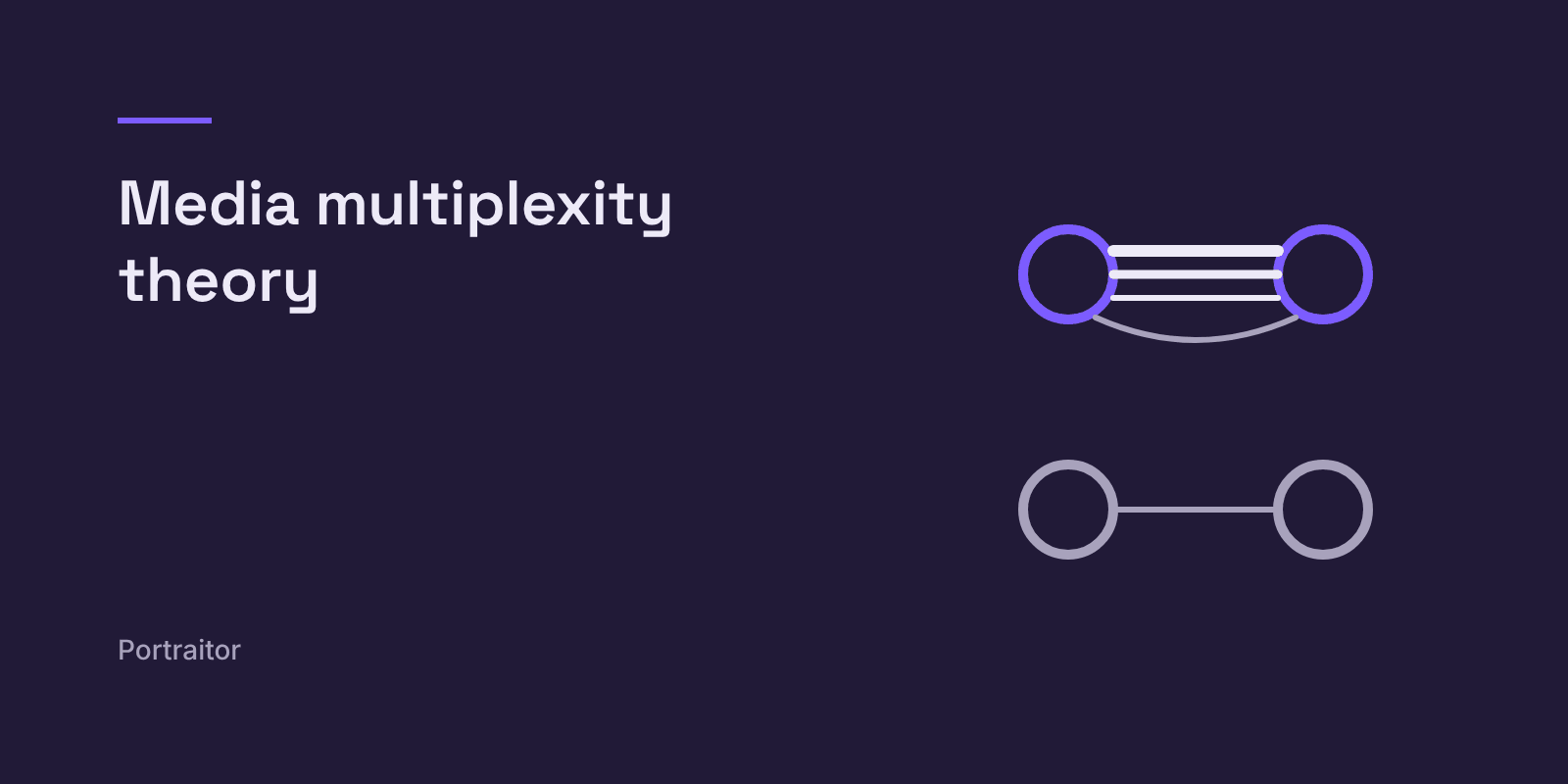
Media multiplexity theory is Caroline Haythornthwaite's finding that the stronger the tie between two people, the more different media they use with each other. Not different media. More of them.
It is a small claim with an awkward consequence for anything built on an export, including this one. If closeness shows up as a count of channels, then a single exported conversation is one line of a tally that the theory says has several lines in it.
A note on sourcing before anything else. The primary paper is Haythornthwaite's 2005 article in Information, Communication and Society, volume 8, pages 125 to 147. What follows is read from a secondary page: the chapter outline on the companion site to A First Look at Communication Theory, which quotes her directly and names that paper as the theory's primary source. Both pages are linked at the foot of this article and both were read today.
The finding Haythornthwaite did not go looking for
The outline records that she started somewhere else entirely. Her question was about online learners, and it is quoted as "What happens to such relationships when face-to-face contact is unavailable or severely limited?" The answer arrived sideways. In her own words, as the outline quotes them, "Asking 'who talks to whom about what and via which media' revealed the unexpected result that more strongly tied pairs make use of more of the available media, a phenomenon I have termed media multiplexity."
The outline is careful about where the finding came from. Haythornthwaite first observed it in educational and organizational groups, and the page says scholars in the socio-psychological tradition took the idea into interpersonal settings afterwards. That ordering is worth keeping, because the version most people meet is the interpersonal one and the evidence began at work and at school.
Five propositions, and the one that travels
The outline lists five. The first is the headline: tie strength is positively associated with media multiplexity. The third says the two cause each other over time, with weak ties described as uncomplicated and not needing many channels, and stronger ties needing more media to orchestrate their varied and interdependent connections. The fourth says a change in the media landscape alters strong ties only minimally but may change the nature of weak ties considerably. The fifth says groups build hierarchies of expectation about which channel is for what, and the outline notes Andrew Ledbetter and Samuel Hardman Taylor found that a change in channel usage is viewed as a violation by family members.
The second proposition is the one that travels into this subject, and it is the one that cuts against the intuition most readers bring. Communication content differs by tie strength, not by medium. The outline says Haythornthwaite found that the medium partners use does not change the topic of their talk. The same page records a live argument about it: with many more and varied channels available now, some scholars think the proposition may not always hold, and Samuel Hardman Taylor is cited speculating that any allocation of topics to channels comes from the affordances of the channel, the properties that enable or constrain certain actions.
So the theory's own literature is not settled on the point that matters most to an export. It is reported here as a claim with a dispute attached, not as a fact.
A thread from one app is a slice of the channel count
Put the first proposition and the second together and you get something specific. If the count of channels is what tracks tie strength, and the content does not change much from one channel to the next, then a single exported thread is reasonably representative of what the pair talks about and says nothing at all about how many other channels they use. The export is informative about content and silent about the variable the theory actually measures.
That is a different limit from the ones usually listed. Media richness theory asks what a lean channel fails to carry, which is a claim about a single medium. Media multiplexity asks how many media are in play at all, which no single export can answer. The two sit beside each other rather than on top of each other, and the hyperpersonal model is a third question again, about what people do with the medium they are in.
The outline also carries the critique, which is fair to repeat. The theory is described as strong on simplicity and weak on explanation and prediction: the hypotheses are testable and quantitative work has tended to support them, but the page notes that Haythornthwaite sometimes emphasizes tie strength driving channel expansion and at other times acknowledges that increased communication probably strengthens the tie, and that media multiplexity might not occur in certain types of relationships.
What that costs a reading built on a single export
Portraitor reads one exported conversation at a time, from WhatsApp, Telegram, Messenger or Instagram, and writes about one participant in it. Nothing in the published pages claims the reading covers a relationship, and media multiplexity is a clean way of saying why that restraint is the right one. A portrait is drawn from one channel of what the theory expects to be several, and a count of one is not evidence of anything in either direction.
The practical form of that is already on the site. What a reading cannot tell you sets out the limits the published pages support, and a group chat raises the same question about everyone else in the thread. If you want to see what a single channel does yield, Portraitor's AI chat analyzer shows the whole flow, including the masking step, before anything is paid for.
The honest summary is that this theory is a reason to read a portrait narrowly. It describes a pattern across pairs in studies. It is not a measure anyone should apply to their own messages to reach a verdict about a person, and the research it rests on does not support that use.
Frequently asked questions
Frequently asked questions
Who created media multiplexity theory?
Caroline Haythornthwaite. The primary source named by the textbook companion page is her 2005 article "Social Networks and Internet Connectivity Effects" in Information, Communication and Society, volume 8, pages 125 to 147.
Does media multiplexity theory say which app close friends use?
No. Its claim is about how many media a pair uses, not which ones. The outline records Haythornthwaite finding that the medium partners use does not change the topic of their talk, and also records other scholars disputing that.
Is the theory settled?
No. The chapter outline calls it strong on simplicity and weak on explanation and prediction, notes that the direction of cause is argued both ways in Haythornthwaite's own writing, and says the pattern may not occur in certain types of relationships.
Can counting the apps you use with someone tell you how close you are?
That is not a use the research supports. The propositions describe an association observed across many pairs in studies, which is a different thing from a measurement that applies to one pair.
Everything above is read from the two companion pages linked below, which quote Haythornthwaite with attribution. Where they stop, this page stops.
Your conversations, read the way you would read someone else’s.
Portraitor takes a chat export you already have, anonymises it in your browser, and returns a structured reading of how you come across. Identifying details are removed in your browser before anything is sent.
See how it works →- Griffin, Ledbetter and Sparks. A First Look at Communication Theory, 11th edition, chapter outline for Media Multiplexity Theory, quoting Caroline Haythornthwaite. Secondary source, read 13 November 2026.
- Haythornthwaite (2005). Social Networks and Internet Connectivity Effects, Information, Communication and Society, vol. 8, pp. 125 to 147, named as the theory's primary source on the companion sources page.