Will a chat analysis give the same result twice?
Section 9 of the Portraitor terms says the same input can produce different results at different times. What that fixes between two runs, and what it leaves moving.
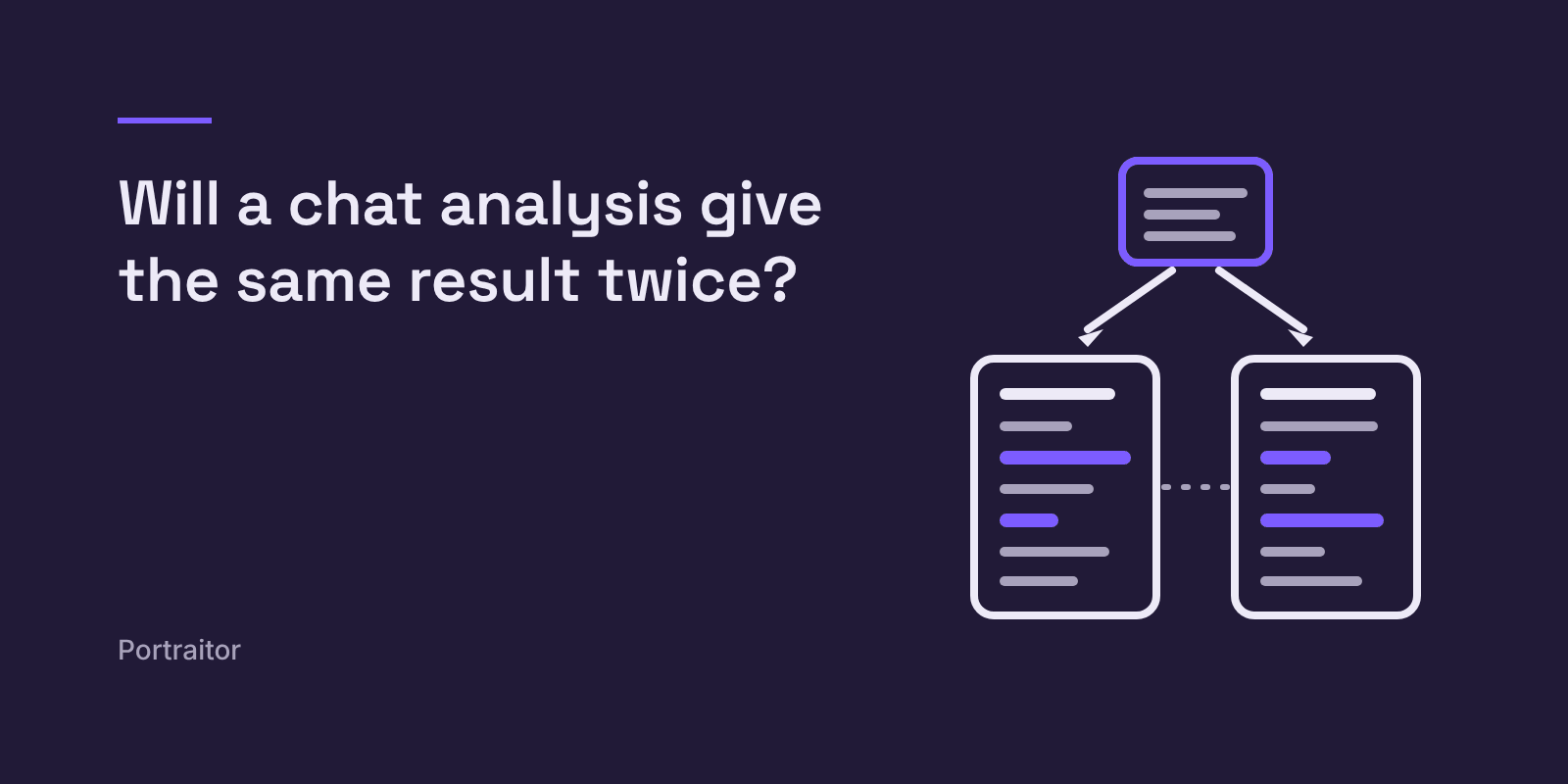
No. Section 9 of the Portraitor terms of service states that the same input can produce different results at different times, and that output is probabilistic rather than deterministic. The shape of the portrait is fixed between two runs. The reading inside it is not.
That sentence is published on the terms page, under the heading AI limitations, as something you acknowledge before you buy. This page reports what the clause says, what the other published pages add to it, and which parts of a second reading are fixed even though the reading itself is not.
The clause that answers this, word for word
Section 9 of the terms of service is headed AI limitations. The copy read on 2 November 2026 is version 1.3, last updated 30 September 2026. It opens by saying the Service relies on a third-party artificial-intelligence provider, then lists what you acknowledge. Four of those statements bear on this question.
The second one answers it outright. “The same input can produce different results at different times. Output is probabilistic rather than deterministic.”
The first sets the frame for it. “AI output can contain errors, biases, or fabrications, and we make no warranty as to its accuracy, completeness, or suitability.”
The third says Portraitor does not control the provider’s models, its training data, or its outputs. The fourth says that confidence figures shown in a portrait are the model’s own estimates, not measurements, and should be read as such.
Those are published statements rather than an inference from one, and they sit on the page you pass through before paying rather than in a note afterwards. The home page makes a related argument in its own words, in the block about using a general AI tool instead, where it says consistency does not mean accuracy. There it is a claim about a different product. In section 9 it is a statement about this one.
What stays put between two readings
The useful way to hold this is that the container is fixed and the contents are not. Four things do not move between a first and a second run.
The input. Your export is a file, and it is the same file. The privacy policy says names, email addresses and telephone numbers are replaced on your own device before anything is transmitted, and that this removes who is speaking but does not remove what was discussed. That step runs the same way on the same text.
The person. The home page says Portraitor analyses whoever you name before starting, from the names it detects in the chat. One portrait is about one named participant, which is also the limit covered in what a chat analysis cannot tell you.
The shape. The home page describes the output as a structured portrait with confidence estimates, read through four lenses on the same conversation. Two runs give you the same sections and the same kinds of figure, in the same order.
The commercial position. Visible pricing is $10 for a single portrait with no account and no renewal, or ten portraits a month on a $19 Pass, and section 8 of the terms says the portrait returned to you is yours to use for personal purposes with Portraitor claiming no ownership of it. Those do not change because the reading did. The cost page goes through both prices.
What moves is the reading: the wording, the emphasis, the figures. Section 9 puts no bound on how far.
Why a second reading cannot build on the first
This is the part that is specific to how Portraitor is built, and it is the reason the variation is structural rather than a fault in one run.
The privacy policy says the conversation is not stored: it is held only for as long as generation requires, is discarded once the portrait has been produced, and conversation text is never written to the database, the backups or the logs. A very large conversation arrives in parts into a temporary file on the server, and at the point the analysis request is assembled that file is consumed and deleted; an upload abandoned part-way becomes unreadable after fifteen minutes. The security section adds that no permanent copy of a conversation is retained on the servers and that no administrative function can read a conversation or a portrait.
The portrait is covered the same way. The privacy policy says the inferences are not retained and that nobody at Portraitor can read them. Section 2 of the terms puts it in one line: Portraitor keeps no copy of the portrait and cannot reissue it if you lose it.
Put those together and a second run begins from nothing. There is no stored first conversation and no stored first portrait on Portraitor’s side, so there is nothing for a second reading to be checked against or reconciled with. A service that kept your conversation and your portrait could anchor a second reading to the first. This one has published that it keeps neither, and the variation section 9 describes is the price of that. What the policy says about training covers the retention the policy states it cannot switch off at the provider, which is where the policy says submitted content is held for a limited period.
The limit in the same sentence: copies do exist, and they are yours. The policy says your portrait history, including the conversations you submitted, sits in your own browser, and the portrait is also sent once to the address you gave at checkout. What happens if you close the tab covers what that browser storage does and does not survive.
One more detail from the policy belongs here, because it is where variation can enter: a long conversation is analysed in sections, each sent separately in anonymised form, and the results are combined into one portrait.
A confidence figure does not carry across runs
A portrait carries numbers. The privacy policy says each inference comes with an estimate of confidence, and that the analysis also estimates the language of the conversation and whether messages appear to have been written with the help of an AI tool. The home page shows confidence figures in its sample.
Section 9 says what those numbers are: the model’s own estimates, not measurements, and to be read as such. That is the whole answer to what you do with a figure that reads differently on a second run. Nothing about the conversation changed, because the conversation is the same file. Two figures from two runs are two estimates of one piece of text, not two measurements of something that moved.
Two older pages are worth reading next to that. Why personality descriptions feel accurate covers the 1949 work on why a general description can feel exact, and the page on the AI writing estimate covers what one of these figures is and is not.
What running it again actually costs
A second reading is a second portrait in the commercial sense, whatever your reason for wanting one. The home page says so plainly in the answer about the wrong person being analysed: fixing it means running it again, which uses another portrait. On a Pass that is one of the ten, and section 6.2 of the terms says each renewal restores the allowance to ten and that unused portraits expire at the end of the monthly period rather than carrying forward.
The terms describe one refund that happens without being asked. Section 7.2 says that if the portrait cannot be generated, or the removal of identifying details on your device cannot complete, nothing is transmitted and the charge is reversed automatically, and that for a Pass the portrait is returned to the allowance instead. Section 7.1 states separately that the fourteen day cancellation period a consumer in the United Kingdom or European Union would ordinarily have does not apply to these purchases, because a portrait and a Pass allowance are supplied as soon as you pay. The refund page sets out those clauses in full.
There is no comparison feature on either side of this. The published pages describe one conversation going in and one portrait coming out, and the home page says a conversation split into parts has each part counting as a separate analysis. Narrowing a chat to part of its history inside one run is a different control, and the page on analysing only part of a chat covers what it does and does not change.
Reading a portrait that could have come out differently
The honest limit of this page is that section 9 says the results can differ and says nothing about how much. It puts no figure on the difference, does not say which parts of a portrait are the steady ones, and the four pages Portraitor publishes do not answer it elsewhere. That is a gap in the published position, and this page stops at it rather than filling it with a number.
There is also no accuracy figure anywhere on those pages, which is consistent rather than evasive: section 9 makes no warranty as to accuracy, so a percentage would contradict the clause above it.
What the clause is good for is expectation. A buyer who reads section 9 first knows they are buying one careful reading of a written record, delivered once, from a service that keeps neither the record nor the reading. A buyer who wanted a fixed score to hold steady is buying the wrong thing, and the published pages say so before payment rather than after it. Portraitor sets out the flow and the two prices.
Frequently asked questions
Frequently asked questions
Will I get the same portrait if I upload the same chat twice?
No. Section 9 of the Portraitor terms states that the same input can produce different results at different times, and that output is probabilistic rather than deterministic. The sections and the kinds of figure are the same; the reading inside them is not.
Does Portraitor keep my first portrait so a second one can match it?
No. Section 2 of the terms says Portraitor keeps no copy of the portrait and cannot reissue it if you lose it, and the privacy policy says conversation text is never written to the database, the backups or the logs. The copies that exist are the one in your own browser and the one emailed to you.
Are the confidence figures in a portrait measurements?
No. Section 9 says confidence figures shown in a portrait are the model’s own estimates, not measurements, and should be read as such. The privacy policy says each inference carries an estimate of confidence.
Is a second portrait free if the first one did not help?
The automatic refund in section 7.2 of the terms covers a portrait that cannot be generated, or on-device removal of identifying details that cannot complete, in which case nothing is transmitted and the charge is reversed. The home page says that running an analysis again uses another portrait.
Do the published pages say how much two readings can differ?
No. Section 9 states that the same input can produce different results at different times and puts no figure on the difference. None of the four pages Portraitor publishes answers it, so this page does not either.
The clause that answers this question is on the terms page before you pay, which is the only place it is worth anything.
Read section 9 before you pay
Portraitor publishes what a portrait is: an estimate produced afresh, from a conversation it keeps no copy of. One portrait is $10, or ten a month on a Pass.
See how Portraitor works →